
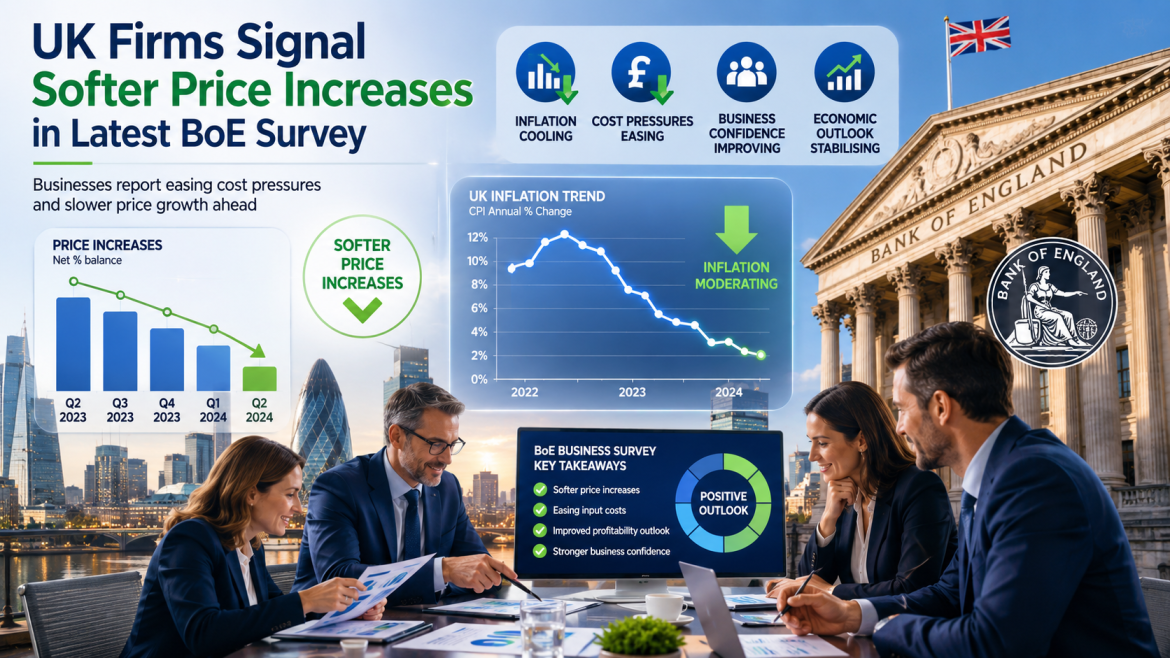
British businesses expect to raise prices at a slower pace over the next 12 months as the impact of the energy price shock triggered by the Iran conflict begins to ease, according to a survey published by the Bank of England on Friday.
The Bank’s Decision Maker Panel found that firms expected prices to increase by 4.0% over the coming year in May, down from 4.4% in April, which was the highest level recorded in more than two years. However, expectations remained above the 3.4% forecast in February before the conflict began.
On a three-month moving average basis, price expectations increased by 0.2 percentage points to 4.0%, marking the highest reading since February 2025.
The survey of more than 2,000 UK businesses found that 57% of firms planned to increase prices in response to higher energy costs, down from 64% in April. Meanwhile, 68% continued to expect lower profit margins, unchanged from the previous month.
Energy prices have risen sharply since the outbreak of the U.S.-Israeli conflict with Iran in late February, and the Bank of England is closely monitoring how much of these higher costs businesses pass on to consumers before making further interest rate decisions.
Other business surveys have also indicated that many companies are preparing to implement price increases in response to rising operating costs and ongoing economic uncertainty.
Financial markets currently expect the Bank of England to leave interest rates unchanged at 3.75% this month, although investors continue to price in one or possibly two quarter-point rate increases later this year.
The latest Decision Maker Panel survey is also likely to support the Bank’s view that the UK labour market is weakening, reducing businesses’ ability to pass on higher costs through increased prices.
Companies surveyed in May said they expected employment levels to fall by 0.4% over the next 12 months, representing the largest planned reduction in six months. Expected wage growth remained at 3.4% on a three-month average basis, matching its joint-lowest level since the survey began regular tracking in July 2022.
“Rate setters can probably take some comfort that second-round effects through firms’ inflation expectations seem muted for now, and they need to contend with weaker job growth,” Rob Wood, chief UK economist at Pantheon Macroeconomics, said.

