
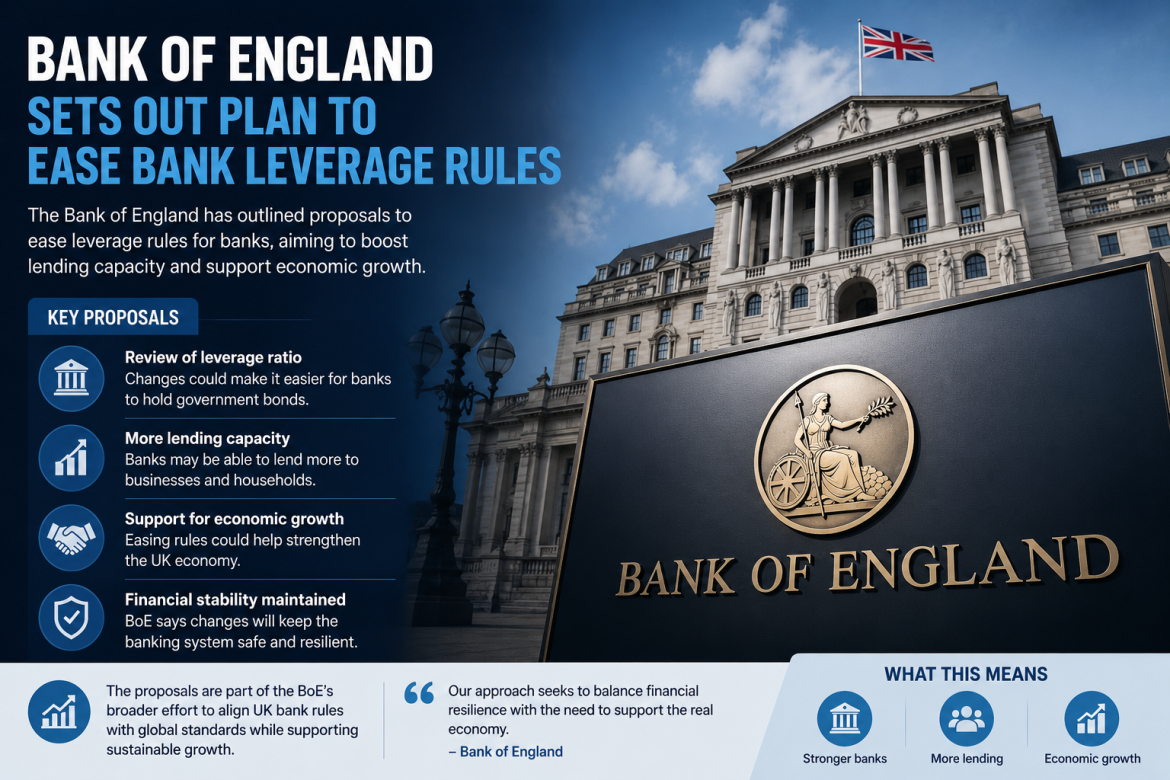
The Bank of England has unveiled plans to relax bank capital rules, aiming to bring UK regulatory requirements more closely into line with international standards while maintaining the resilience of the financial system.
The proposals, announced by the Bank’s Financial Policy Committee (FPC), would reduce the impact of the leverage ratio, which requires banks to hold a minimum level of capital against their total assets, and make capital buffers easier to use during periods of financial stress.
The Bank also announced plans to improve the usability of capital buffers, allowing them to be released more effectively without automatically triggering restrictions on shareholder payouts or dividend distributions.
However, some members of the Financial Policy Committee warned that the proposed reforms could encourage higher levels of market-based borrowing, potentially creating new risks for the stability of the UK’s financial markets.
The latest review follows the Bank of England’s decision in December to reduce its estimate of the capital required by major lenders from 14% to 13%, marking the first reduction since the global financial crisis.
The review was launched after similar regulatory changes in the United States and reflects concerns that the UK’s leverage framework has become more restrictive than those applied in other major financial markets.
The Bank said the leverage ratio, originally introduced as a safeguard alongside risk-based capital requirements, has become a binding constraint for three of the UK’s seven largest banks, placing them at a competitive disadvantage compared with international peers.
Under the proposed reforms, the Bank of England would remove the Countercyclical Leverage Buffer from the leverage ratio calculation and make a larger proportion of other capital buffers releasable, reducing leverage requirements for major UK banks by an estimated 0.2 percentage points from their current level of just over 3%.
The changes would make the framework “more proportionate and more effective by being better targeted,” the FPC said.
The Association for Financial Markets in Europe, representing large banks, said it welcomed the changes.
“The (leverage ratio) framework incorporates significant gold-plating and has become increasingly binding. Addressing these issues requires more than incremental adjustment so we are pleased to see that the FPC and PRA will consult on a package of measures,” Jeanie Watson, AFME’s director for capital and risk management, said.
In its latest Financial Stability Report, the Bank also highlighted growing risks to the financial system from increased borrowing to finance equity investments, rising cybersecurity threats linked to artificial intelligence, and the concentration of investor exposure to AI and technology companies.

