
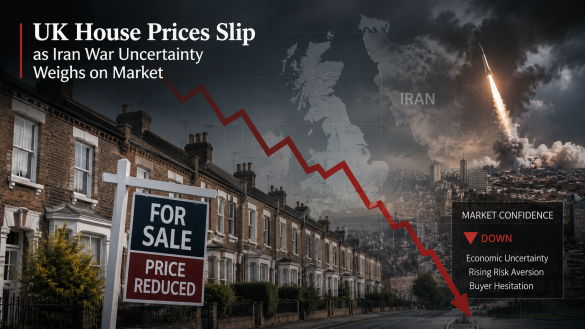
British house prices declined by 0.6% in May, marking their first monthly fall since December, as uncertainty linked to the conflict in Iran weighed on buyer confidence and housing demand, according to data released by mortgage lender Nationwide on Monday.
The drop was the steepest monthly decline since June 2025 and exceeded economists’ expectations in a Reuters poll, which had forecast a more modest 0.2% decrease.
On an annual basis, house price growth also lost momentum. Prices were 1.7% higher than a year earlier in May, slowing from the 3.0% increase recorded in April and falling short of analysts’ forecasts for a 2.2% rise.
The figures suggest the housing market is coming under increasing pressure as geopolitical uncertainty, rising energy costs and a weaker economic outlook dampen consumer sentiment and reduce appetite for property purchases.
“Given the uncertainty caused by developments in the Middle East and the subsequent rise in energy prices and market interest rates, some loss of momentum was to be expected,” Nationwide chief economist Robert Gardner said.
“Consumer confidence has weakened noticeably since the start of the conflict.”
Average mortgage rates have risen since the outbreak of the Iran conflict, as financial markets increasingly expect the Bank of England to raise interest rates later this year rather than begin cutting them.
Higher expectations for future rate hikes have pushed up borrowing costs across financial markets, making mortgages more expensive for homebuyers and homeowners looking to refinance.
Data from Rightmove released on Friday showed that the average two-year fixed mortgage rate climbed to 5.13%, while the average five-year fixed rate reached 5.15%.

